






Panasonic KX-UT670 IP Phone


Key Note
- 6 SIP accounts
- 7 inch touch display
- HD Voice (G.722)
- 3-way conference call support
- Compatible with Asterisk and Elastix
- 2 x GbE ports, PoE
- Linux based open source operating system
- Full duplex speaker phone


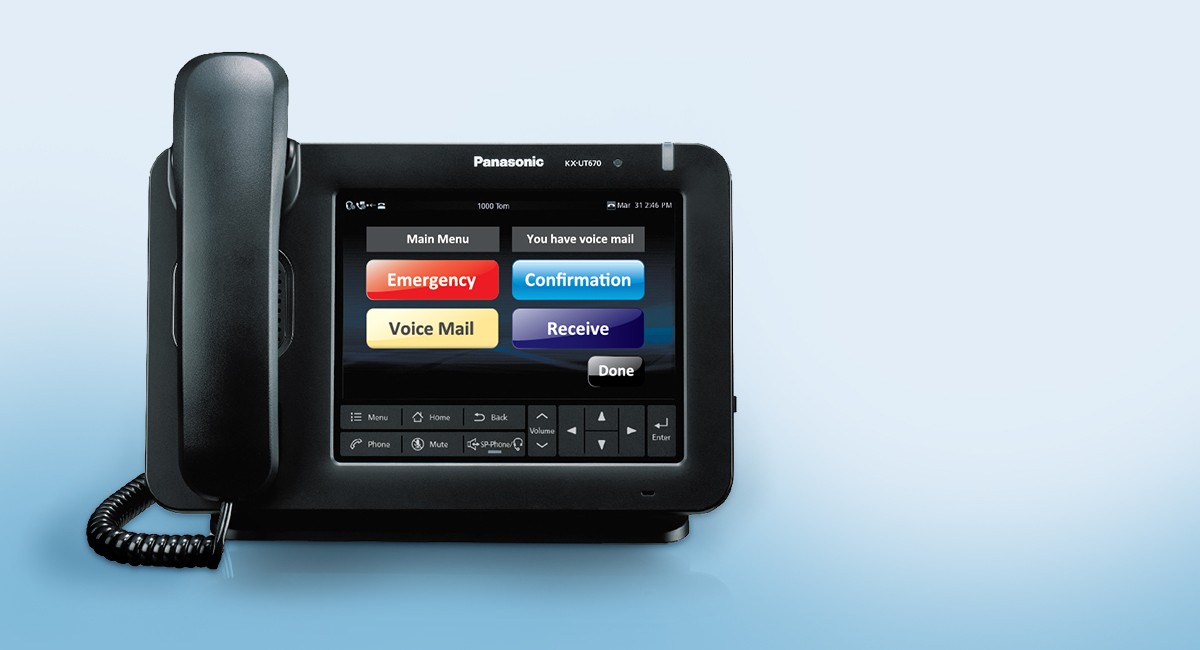
The Panasonic KX-UT670 Phone features a 7-inch touch screen, HD video capability, HD audio and six SIP terminals. The phone capabilities include storage for up to 100 contacts, 3-way conference calling, two Ethernet ports, IP camera integration, a full duplex speakerphone and is PoE ready.
The Panasonic KX-UT670 Executive Touchscreen Desk Phone is the top of Panasonic’s KX-UT line of VoIP Phones. This highly expandable-corded phone features a 7-inch touch screen is made to transform business communication. It supports 6 SIP accounts, HD quality video and audio, storage for up to 100 contacts, 3-way conference calling. The KX-670 features two Gigabit Ethernet ports, a SD card slot and a single USB port. This VoIP phone is Power over Ethernet ready, which eliminates the need for extra electrical adaptors. The HD Audio of the KX-UT670 utilizes echo cancellation and an expanded acoustic chamber which ensures that every word is heard clearly. The Panasonic KX-UT670 is perfect for the executive that wants to streamline and transform their business communication for maximum success.
Compatible with:

| Display | |
|---|---|
| LCD Display | 262,000 colors |
| LCD Size | 7 inch touch display |
| LCD Backlight | 15/Auto |
| HD Video | 720p |
| Install Options | |
| Desk Mount Tilt | Yes – 2 positions |
| Wall Mount | KX-A434 (optional) |
| Power Adaptor | KX-A422 (optional) |
| Audio Features | |
| Handset, Speaker, Headset Volume | 15 levels |
| Ringtones | 32 |
| Ringer Volume | 7 levels + Off |
| Headset Port | 2.5 mm |
| Electronic Hook Switch Control Port*1 | 3.5 mm |
| Audio Codec | G.711a-law / G.711µ-law / G.722 (wideband) / G.729a |
| HD Voice | Yes |
| Speaker Phone | Yes (Full Duplex) |
| Keys | |
| Programmable Keys | 24 (4 pages of 6 keys)*2 |
| Software Features | |
| Phone Book (Entries) | Depends on memory |
| Call Log Entries | 100 in + 100 out |
| Conferencing | 3 parties (within terminal – multi-party dependent on server) |
| Music on Hold | Supplied by Host Service (PBX / SIP Server) |
| Memory | 50 MB |
| IP Features | |
| SIP Accounts | 6 |
| SIP Compatibility | RFC 3261 Standard SIP Server, Asterisk, Broadsoft, CommuniGate Pro, Panasonic IP PBX |
| IP Version | IPv4 |
| DHCP Client | Yes |
| DNS | Yes |
| HTTP | Yes |
| HTTPS | Yes |
| SNTP Client | Yes |
| VLAN (802.1q) | Yes |
| QoS (DiffServ) | Yes |
| Configuration | |
| Plug & Play Configuration | Server based configuration |
| Manual Configuration | Internal web Configurator, Local (LCD based) network configuration |
| Interface | |
| Ethernet Ports | 2 |
| Ethernet Interface | 10/100/1000 Mbps |
| PoE (Power over Ethernet) | Yes |
| Bluetooth | No |
| USB | 1 (USB 2.0 Host) |
| SD Card Slot | SDXC Memory Card / SDHC Memory Card / SD Memory Card |
| Power Consumption | PoE Standby: 5.2W (Backlight OFF) Talking: 7.0W Max: 12.9WAC Adaptor Standby: 4.6W (Backlight OFF) Talking: 6.2W Max: 11.5 W |
| Operating Environment | 0 °C – 40 °C (32 °F – 104 °F) |
Dimensions
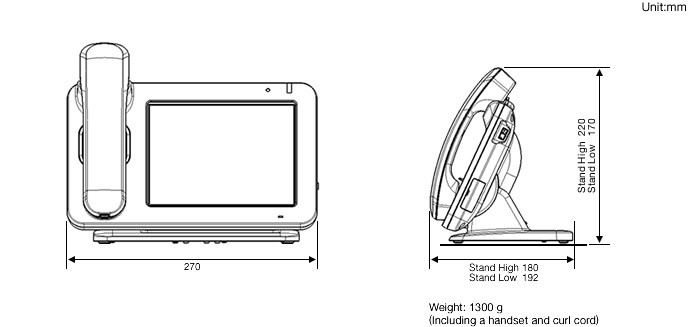
(Width x Depth x Height; handset on cradle, stand attached)
High position:
270 mm x 180 mm x 220 mm
Low position:
270 mm x 192 mm x 170 mm
Weight
(with handset, handset cord and stand): 1300 g

KX-UT670 APIs provide an environment for developing applications that enhance business productivity and service with the Panasonic KX-UT670 Smart Desk Phone. They let you develop applications that meet customer needs, and operate them on the Smart Desk Phone.
Usage Example
Applications can be developed for use by a variety of businesses.

The screen can be used to search for information about the area around the hotel.
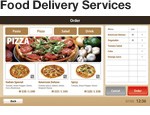
Orders can be placed directly from the on-screen menu.

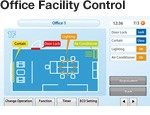
The screen can be used to open or close curtains, and to turn the air conditioner on or off.
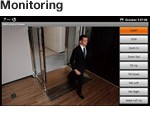
The network camera image can be viewed on-screen, and operating buttons can be changed as necessary.
- The images shown here are simulated application screens.
Usage Example
The KX-UT670 is based on open-source software. KX-UT670 applications are developed in the same manner as those for other devices.
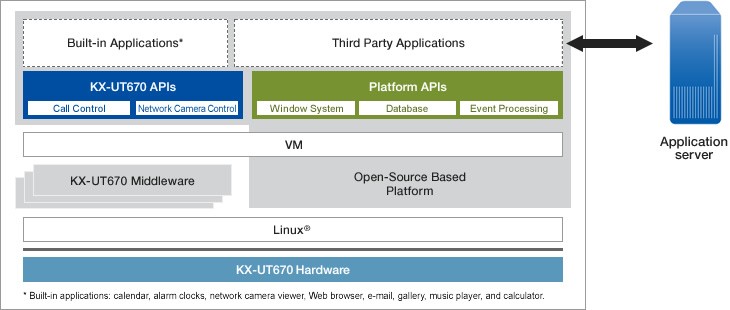
- Applications developed by using these APIs are exclusively for use with the Panasonic KX-UT670 Smart Desk Phone.
They will not operate on devices other than the KX-UT670.
1) Development Environment
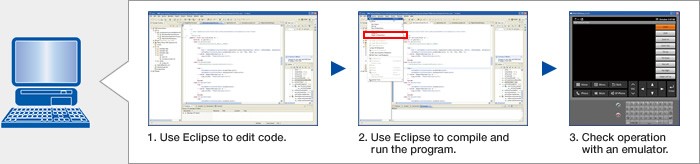
Download Eclipse (an integrated development environment containing an editor, compiler and debugger) to your Windows® or Linux® PC, then download open-source based SDK for Android development use. Next, add-on the KX-UT670 APIs. The Android development environment can be used for developing applications.
- Applications developed by using KX-UT670 APIs are exclusively for use with the KX-UT670. Do not distribute them for use on other devices.
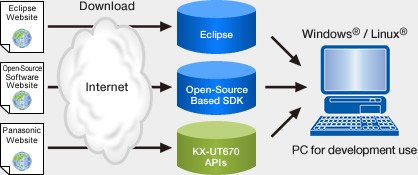
2) Edit Code, Compile and Confirm Operation
Programs are developed using Java™ programming language. Code editing and compiling are done with Eclipse (other editors and compilers can also be used). After compiling, an emulator can be used to do basic debugging on a PC.
3) Install onto the KX-UT670 and Confirm Operation
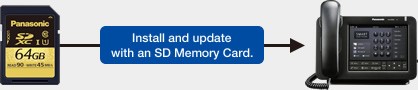
Install from an SD Memory Card
Use an SD Memory Card to install the finished application onto the KX-UT670.
Install from the Web Server
Open a Web browser from the administrator screen of the KX-UT670, then download the application from the server and install it.
- Requires an SD Memory Card into the KX-UT670 for downloading the application file.

API Application
The following API types are available.
| Telephone Operation API | Invokes KX-UT670 telephone functions (call, answer, ring, hold, forward, etc.) from the application. |
|---|---|
| Audio Control API | Controls the speakerphone, headset, 3-way conversation function, etc., provided in the KX-UT670 Smart Desk Phone. |
| OAM (Operations, Administration and Management) API |
Controls user log deletion, device reset, etc. |
| IP Network Camera Control API |
Controls an IP network camera. *Supports Panasonic network cameras (complying with the PS interface). |
| Device Control API | Controls screen brightness, LED ON/blink, etc. |
Trademarks and registered trademarks
– Android is a trademark of Google Inc.
– Oracle and Java are registered trademarks of Oracle and/or its affiliates. Other names may be trademarks of their respective owners.
– Linux is the registered trademark of Linus Torvalds in the U.S. and other countries.
– Microsoft and Windows are either registered trademarks or trademarks of Microsoft Corporation in the United States and/or other countries.